
The Ball Turret
The Ball Turret
Of the crew positions on the B-17 Flying Fortress heavy bomber, the loneliest  was the ball turret. Set into the belly of the aircraft, the gunner in the ball was physically isolated from the rest of the crew. While his view to the earth below was unobstructed and he could rotate a full 360 degrees, he was susceptible to the same hazards—sub-zero temperatures, enemy fighters, flak—as his crewmates plus he ran the risk of mechanical malfunctions that could trap him inside his turret. For long hours, the gunner had to remain at his post, folded into such a cramped space that the ball turret was usually the domain of the smallest man on the crew. Once over enemy territory, the ball turret gunner had to remain on his guns to protect his aircraft—and his crewmates—against fighter attacks from below. Albert Outz Kemp was the ball turret gunner aboard an 8th Air Force B-17 and a member of Clemson’s Class of 1945.
Kemp was from Trenton in Edgefield County and came to Clemson in 1941 to study engineering. He stayed on campus only his freshman year and entered the Army at Fort Jackson in March 1943. After basic training at Jefferson Barracks, Missouri, Kemp was assigned to aerial gunnery school. Upon completion, he was promoted to sergeant and assigned to an operational unit for further training and familiarization. Kemp joined the B-17G crew of pilot Second Lieutenant William Wilson. The crew flew to England on October 17, 1944 and joined the 563rd Bomb Squadron of the 388th Bomb Group operating out of Knettishall in Suffolk, England.
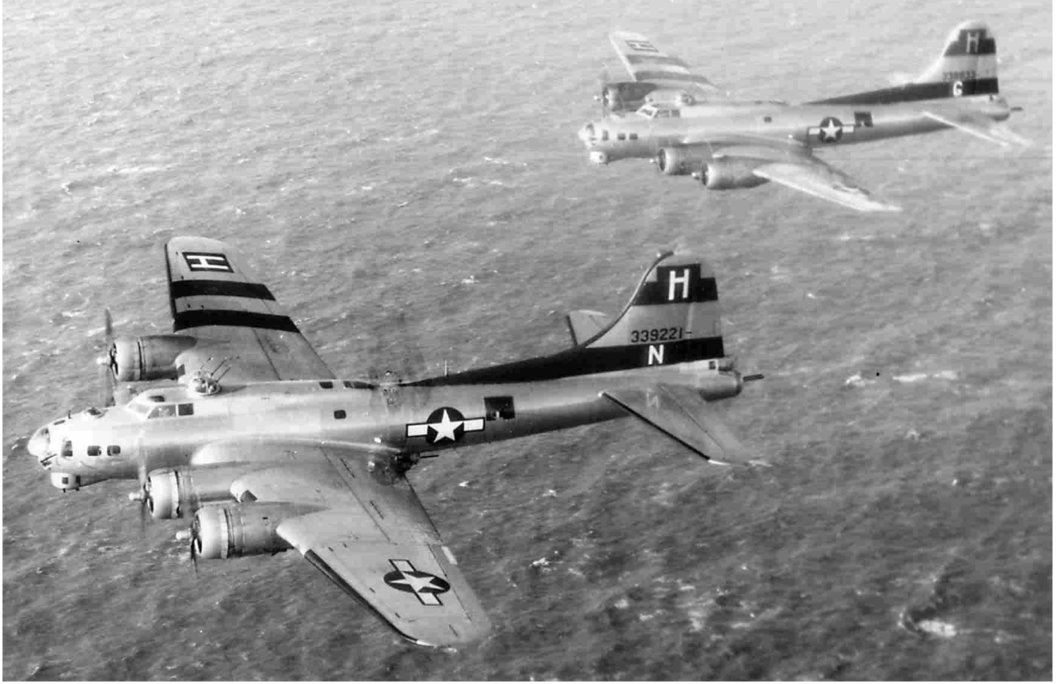
388th Bomb Group B-17Gs
On November 6, 1944, Kemp and the rest of the crew were alerted for their first combat mission. After takeoff, the aircraft experienced engine trouble and Wilson aborted the mission, returning to Knettishall. Three weeks later, on November 25, the Wilson crew got its second chance at its first mission. Three hundred eighty-eight heavy bombers were dispatched to attack the Leuna synthetic oil plant at Merseburg, Germany. By 0730, all of the group’s bombers were in the air where they assembled into a large attack formation with bombers from other groups and turned on the briefed course toward Germany. As they approached enemy territory, Kemp climbed through the hatch into the four-foot diameter ball where he would spend the next few—and last—hours of his life.
The target area was covered by clouds, so Pathfinder aircraft equipped with 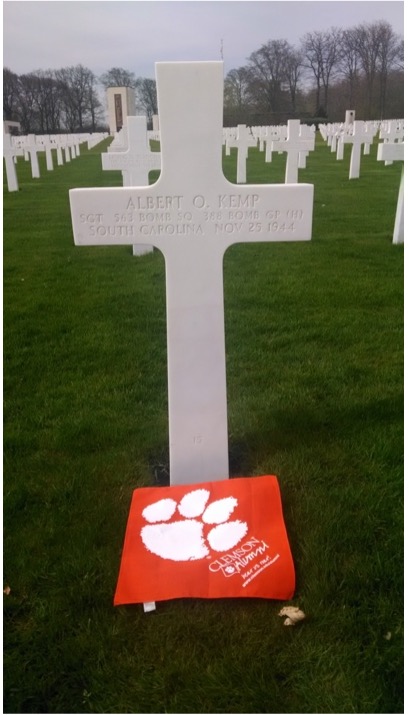 air-to-ground radar led the bomb run. From approximately 1130 to almost noon, the bomber formation streamed over the target and let loose its bombs on the synthetic oil plant. Anti-aircraft fire was intense and accurate with 33 bombers receiving major damage and 104 suffering minor damage. Second Lieutenant Wilson’s plane was among those hit the hardest. Nursing a crippled aircraft and with all of the crew members wounded, Wilson tried to keep his bomber in the air long enough to cross Allied lines. He didn’t quite make it. The aircraft crash landed in a forest near Arenrath, about twenty miles east of the Luxembourg border. Three of the nine crewmen aboard survived the landing and were taken prisoner by the Germans. The other six, including Kemp, were buried in a local cemetery. After the war, Kemp was removed to the Luxembourg American Cemetery.
For more information on Sergeant Albert Outz Kemp see:
https://soh.alumni.clemson.edu/scroll/albert-outz-kemp/
For additional information about Clemson University’s Scroll of Honor visit:
https://soh.alumni.clemson.edu/
B-17G photo courtesy The American Air Museum in Britain