
Scroll of Honor – William Carter
Gulf of Tonkin
On August 2, 1964, the destroyer USS Maddox was conducting a signals 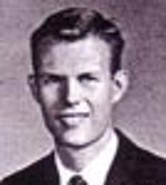 intelligence patrol in the Gulf of Tonkin, off the coast of North Vietnam. Maddox, operating in international waters, was fired upon by three North Vietnamese torpedo boats. One US aircraft was damaged, as were the three North Vietnamese boats. Although there were no US casualties, President Lyndon Johnson used the skirmish to justify the escalation of American involvement in Vietnam. Soon, American ground forces would begin a buildup that would continue through the end of Johnson’s presidency and lead to bitter division within American society. This incident off the coast of Southeast Asia would set in motion a chain of events leading up to a tragic mission a little more than two years later.
William Thomas Carter was already in the Navy in August 1964. Carter, from the Horry County community of Longs, had graduated from Clemson on January 25th with a degree in biology. He had then reported for active duty and headed to Navy flight school. As Army and Marine Corps forces 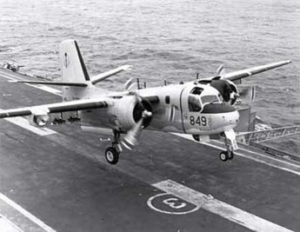 deployed to South Vietnam, the Navy increased its air and sea operations in the Gulf of Tonkin. This included rotating its aircraft carriers into these now-hazardous waters. In August 1966, it was the turn of the USS Kearsarge to head into the neighboring South China Sea.
Kearsarge was an antisubmarine aircraft carrier. Its complement included Sea Control Squadron 21 and its specially equipped antisubmarine aircraft. In October, Lieutenant (junior grade) Carter arrived on Kearsarge as one of the squadron’s pilots. Carter and his squadron mates flew S-2E Tracker aircraft and helped protect US vessels from North Vietnamese gunboat attacks. When a US ship suspected its position was being probed by an enemy boat, Trackers would be called in to locate enemy activity and provide air cover.
At 2230 hours on November 9, 1966, a Tracker with Lieutenant (JG) Carter as its copilot launched from Kearsarge’s flight deck on a night surveillance mission. The procedure for such missions was to orbit in an assigned area, monitoring enemy signals and responding to requests from friendly vessels in the area. If a potential enemy target was identified, the Tracker would drop a parachute flare from an altitude of 10,000 feet and then descend to about 300 feet above the sea to engage and destroy enemy boats. These missions were dangerous because those enemy boats had not only weapons but radar as well.
Carter’s crewman had located a possible enemy boat, and the aircraft was investigating when it lost contact with Kearsarge at 0145 hours on November 10. Since radar contact was typically lost when the Tracker descended on a possible attack run, no alarm was raised aboard the carrier until Carter’s aircraft was noted as overdue nearly three hours later. A search and rescue operation, including both aircraft and a destroyer, was ordered into the area. The destroyer observed aircraft wreckage and recovered a flight crewman’s helmet, but no bodies were recovered. Carter and the three other crew members were first reported missing. A day later, they were reclassified as killed in action. The Navy surmised that “the aircraft made an uncontrolled contact with the water.”
Lieutenant (JG) Carter was survived by his parents, brother and sister. He is 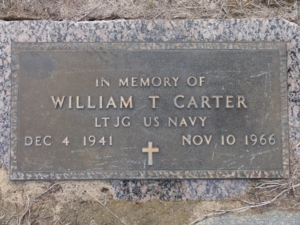 memorialized on the Courts of the Missing at the Honolulu Memorial, Hawaii, the Vietnam Memorial in Washington, DC, the Horry County Vietnam Memorial in Conway, and Buck Creek Baptist Church Cemetery in Longs.
Click here for more information on William Thomas Carter.
For additional information on Clemson University’s Scroll of Honor, click here.