
Scroll of Honor – William Henry Frazier, Jr.
Uncommon Hero
Written by: Kelly Durham 
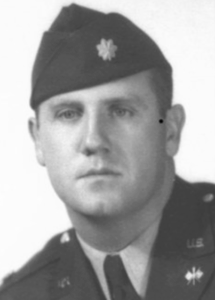
William Henry Frazier, Jr. was unique in that he was the only graduating member of Clemson’s Class of 1939 from the state of Alabama. Frazier was uncommon in other ways as well.
Bill Frazier came to Clemson from the south Alabama city of Dothan, about eighty miles north of Panama City, Florida. He was an electrical engineering major, a member of both the American Institute of Electrical Engineers and the Radio Club. Frazier marched with the Band Company and was a member of the Concert Band as well. His musical prowess landed him in Mu Beta Psi, the national honorary music fraternity. He was active in the Palmetto Literary Society and the International Relations Club. A first lieutenant in the Cadet Brigade, Frazier returned to his home state the summer between his junior and senior years to attend ROTC training at Fort McClellan.
After graduation, Frazier returned to Dothan and was employed by the Alabama Power Company. He was called to active duty in 1941 and served in the Army during World War II.
After the war, Frazier remained in the Army and was posted to Gunter Field, northeast of Montgomery, Alabama. While there, Frazier renewed a casual friendship with Janet Isbell, a University of Alabama graduate who was working as a receptionist in the office of Governor Jim Folsom. In November 1947, Bill and Janet were wed. Their son, William Henry Frazier, III was born in September 1949.
In June 1949, Frazier completed the Advanced Infantry Officers Course at Fort Benning, Georgia. He was then assigned to Fort Lewis, Washington where he assumed the duties of executive officer of 3rd Battalion, 9th Infantry Regiment, part of the 2nd Infantry Division.
 When North Korean invaded South Korean in June 1950, the 2nd Infantry Division was alerted for deployment. It shipped out for Korea in July. Upon its arrival, the 2nd joined the beleaguered United Nations defenders holding the Pusan Perimeter, the southeastern corner of the Korean Peninsula. From this toehold, into which the surprise invasion had forced US and South Korean defenders, American forces built up their strength to launch a counteroffensive. The breakout began one day after UN forces under the command of General Douglas MacArthur staged a surprise amphibious landing at Inchon, on the west coast of South Korean near the capital of Seoul.
By September 28, Major Frazier’s battalion had reached Seoul. In fighting to liberate the capital, Frazier was wounded in the shoulder by fragments from an enemy missile. The wound earned Frazier the Purple Heart medal. In October, after a period of rest and recreation in Japan, Frazier returned to the battalion—and to combat. On November 13, 1950, Frazier was killed in action while fighting near Pugwan, North Korea. Frazier was posthumously awarded a second Purple Heart. In addition to the two awards of the Purple Heart, Frazier also received two Bronze Star medals for heroic or meritorious service in a combat zone. 
Major William Henry Frazier, Jr. was survived by his wife and son. In 1955, his remains were returned to the United States, and he was buried in Arlington National Cemetery. Service in two wars, two Purple Hearts, and two Bronze Stars make Bill Frazier an uncommon hero.
For more information on William Henry Frazier, Jr. see:
https://soh.alumni.clemson.edu/scroll/william-henry-frazier-jr/
For additional information about Clemson University’s Scroll of Honor visit:
https://soh.alumni.clemson.edu/