
Scroll of Honor – Richard Warren Robinson
Navy Flyer
Written by: Kelly Durham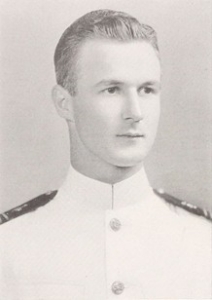
Richard Warren Robinson of Anderson graduated from Boy’s High School and enrolled at Anderson College in 1932. He stayed there for one year and enrolled at Clemson in September 1934. Robinson, a general science major, stayed at Clemson for only the fall semester. After receiving a Congressional appointment, he enrolled at the United States Naval Academy in Annapolis, Maryland in the fall of 1935. Robinson apparently impressed at Annapolis. In The Lucky Bag, the Academy’s yearbook, his classmates wrote “Robbie’s facility for making friends, his will to win, and his knack of doing everything well will make him a hard man to keep down and an asset to the Service.”
Following graduation leave, Ensign Robinson was assigned to a destroyer in the Pacific Fleet. On December 7, 1941, Robinson was at Pearl Harbor when the Japanese thrust the United States into war. He soon returned to the States for flight training at Pensacola, Florida. After earning his wings, Robinson served as the commanding officer of an air base on the island of American Samoa. While there, he courted and married Ruth Turnbull, the daughter of the island’s governor. The Robinsons returned to the West Coast, where he was placed in charge of training Naval Air Squadrons. Following this assignment, Robinson put to sea as the commanding officer of VF-25, a Navy fighter squadron flying from the deck of the USS Chenango.
 Chenango had started its life afloat as a commercial oil tanker, the Esso New Orleans, in 1939. In 1941, the Navy acquired the ship and put it to work fueling the fleet. After the outbreak of war, the ship was converted into an escort carrier. By the time Robinson and his squadron joined the ship, it was operating in the Pacific.
VF-25, equipped with the F6F Hellcat fighter, rehearsed close air support for ground troops in the Solomon Islands in early March 1945. On the 27th, the Chenango got underway as part of the largest invasion fleet of the Pacific war, heading toward Okinawa. On April 1, aircraft from Chenango covered the Marines’ landing along the Hagushi Anchorage on Okinawa’s west coast.
Robinson and his pilots attacked enemy concentrations, supply depots, airfields, and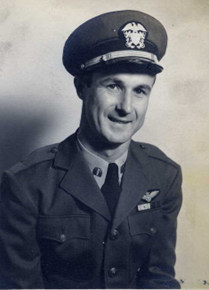 fortifications. The Japanese retaliated against the invasion fleet by launching wave after wave of kamikaze suicide aircraft. Many of these one-way flights originated from Ishigaki, a Japanese-held island between Okinawa and Formosa. The kamikaze base quickly became a priority target for Navy aircraft.
On April 8, one week into the Okinawa operation, Lieutenant Commander Robinson led his squadron in an attack on the Japanese airfield at Ishigaki. In adverse weather conditions, Robinson led his formation on a bombing and strafing run on the target, “diving relentlessly through a shattering hail of anti-aircraft fire,” according to the citation for his Air Medal. After his own “brilliantly executed strike,” Robinson attacked enemy anti-aircraft batteries to protect his squadron’s fliers. After his plane was damaged by enemy fire, Robinson was forced to ditch in the open sea. Robinson drowned in the crash.
 Richard Warren Robinson was survived by his parents, his wife, four brothers—two of whom served in the Pacific—and three sisters. He was awarded the Air Medal and the Purple Heart. He is buried at the National Memorial Cemetery of the Pacific in Honolulu, Hawaii.
For more information on Lieutenant Commander Richard Warren Robinson see:
https://soh.alumni.clemson.edu/scroll/richard-warren-robinson/
For additional information about Clemson University’s Scroll of Honor visit:
https://soh.alumni.clemson.edu/