
Scroll of Honor – Otis Foster Morgan
The Heavy Debt
Written by: Kelly Durham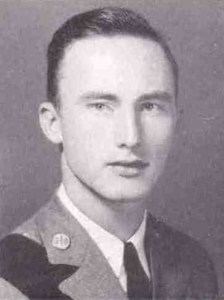
Clemson students of a later generation are familiar with the name of Otis Morgan who was killed in the last year of World War II. They remember him not because of how he died, but because of how he lived.
Otis Foster Morgan arrived on campus during the Great Depression. A civil engineering major from Laurens, Morgan was a member of the American Society of Civil Engineers and the Laurens County Club which he served as secretary. He was associate editor of The Tiger and served as president of the Central Dance Association. Morgan, a member of Alpha Chi Psi fraternity, was listed in Who’s Who Among Students in American Universities and Colleges. As a senior, he served as a cadet first lieutenant and company executive officer after completing ROTC summer training at Fort McClellan, Alabama. After graduating on the final day of May 1938, Morgan lived briefly in Aiken before entering the Army.
Morgan was soon on his way to the Philippines. Described by his friend Manny Lawton as a “neat, square-shouldered, aggressive lieutenant,” Morgan was assigned to a Philippine Scout unit. He later moved to the 71st Engineer Battalion of the Philippine Army’s 71st Infantry Division. The Philippine Army had been established only in 1935 as the Philippines formally became an American commonwealth on a pathway toward eventual independence. The commander of the Philippine Army—as well as American forces in the archipelago—was former US Army chief of staff Douglas MacArthur.
The Japanese attack on the Philippines began on December 8, 1941. American and Filipino forces were eventually pushed back onto the Bataan Peninsula. Morgan’s 71st Infantry Division fell back to Corregidor, the rock island fortress in Manila Bay. Outnumbered, with limited food and ammunition, and with no hope for resupply, Corregidor finally surrendered to the Japanese on May 6, 1942.
Morgan, along with other American and Filipino survivors of Corregidor’s siege were marched north to the prisoner of war camp at Cabanatuan. There Morgan was reunited with his Clemson classmate Ben Skardon. Henry Leitner of the Class of 1937 was also present in the camp.
At its peak, 8,000 POWs occupied Cabanatuan, making it the largest such camp in the Philippines. The compound covered about 100 acres divided by a road that ran through its center. One side of the camp housed the Japanese guards and camp administration. The other side held the prisoners and included a hospital nicknamed the “Zero Ward” because zero was the probability of coming out of it alive.
Ben Skardon’s health had deteriorated at Cabanatuan. He had contracted beri beri and malaria and was suffering from diarrhea. He had grown so weak that he could barely eat and was about to be committed to the “Zero Ward.” Skardon’s story has been oft retold during the ceremony in which Clemson students receive their class rings. Otis Morgan is at the center of the story.
“I was in very, very bad health in the prison camp,” Skardon recalled, “and there was no medicine and no way of improving your health.” Leitner and Morgan kept Skardon alive by massaging his swollen feet and carrying him back and forth to the latrine. Skardon had secreted his Clemson class ring by rolling it up in the sleeve of his uniform. Morgan had learned a little Japanese and worked on a local farm as an “in charge,” a prisoner who could pass along instructions from the Japanese guards to their English-speaking prisoners. To save his friend’s life, Morgan bartered Skardon’s ring for food. “One evening Otis came in from the farm with a small can of potted ham and a live pullet-sized chicken. Henry borrowed a tin pail, built a fire, and boiled the chicken.” Skardon recalled that Morgan and Leitner took turns feeding him. They even broke open the chicken’s bones and pulled out the marrow. “My diarrhea dried up…my appetite was restored.” Skardon regained his health and would survive his captivity. Otis Morgan would not.

Oryoku Maru burning at Subic Bay after being attacked by planes from the carrier Hornet, December 15, 1944.
Morgan spent two years and seven months at Cabanatuan. After American and Filipino forces returned to the Philippines in October 1944, the Japanese began to evacuate POWs, transporting them by merchant ship to become slave laborers in Japan. Morgan, Leitner, and Skardon were among 1,619 prisoners aboard the Oryoku Maru at Subic Bay, Luzon when it was attacked by aircraft from the USS Hornet on December 15. They survived the ship’s sinking but on Christmas Day were transported by train to San Fernando on Lingayen Gulf. Two days later, the Clemson colleagues were loaded onto the Brazil Maru bound for Takao Harbor, Formosa. Upon arrival there, Morgan and his fellow prisoners were transferred to yet another ship, the Enoura Maru. On January 8, 1945, while still at Takao, this ship, which carried no markings identifying it as a POW transport, was attacked by aircraft from the Hornet. Otis Morgan was killed when a bomb struck the port side hold. He was buried in a mass grave along with 294 other POWs killed in the attack. His remains were never repatriated.
First Lieutenant Otis Foster Morgan was awarded the Purple Heart. He was survived by his mother, a brother, and a sister. He is memorialized on the Tablets of the Missing, Manila American Cemetery, the Philippines and on the Memorial Wall at the Aiken County Veterans Park.
In the telling of Ben Skardon’s story, his Clemson ring often gets star billing. “It saved my life,” Skardon said. But Skardon always acknowledged the role of his Clemson comrades, Henry Leitner and Otis Morgan. Their actions converted the ring into the nourishment that rescued him from the “Zero Ward” and offered him a chance for survival. During their long, dark days of imprisonment, Leitner and Morgan ministered to their weakened friend, purchasing with their efforts a second chance for his life. Speaking sixty years after the end of the war, Skardon summed up his feelings: “My debt to Henry Leitner and Otis Morgan is heavy—it cannot be repaid.”
For more information on Otis Foster Morgan see:
https://soh.alumni.clemson.edu/scroll/otis-foster-morgan/
For additional information about Clemson University’s Scroll of Honor visit:
https://soh.alumni.clemson.edu/