
Scroll of Honor – Olin Goode Dorn, Jr.
Holding the Bulge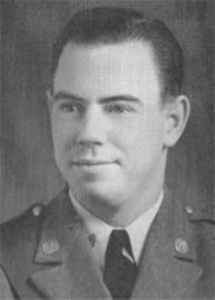
Written by: Kelly Durham
The weather was on the Germans’ side. Time was not. The Germans launched their great winter offensive through the rugged Ardennes region of southeast Belgium on December 16, 1944. The attack caught the American defenders in the First Army sector off guard. By December 21st, the Germans had pushed a bulge into the Allied front reaching some fifty miles to the west. The weather was overcast with low cloud cover and frequent snowstorms, perfect for grounding the overwhelming airpower of the Allies. But the Germans were running out of time. Every day they failed to reach their objectives along the Meuse River was another day for the Allied high command to assemble forces for a counterattack. Among the American forces dispatched to blunt the German salient was the 84th Infantry Division. One of its company commanders was Olin Goode Dorn, Jr., Clemson College Class of 1942.
“Goot” Dorn was an agricultural engineering major from Sumter. He was a member of Blue Key, the American Society of Agricultural Engineers, and chaired the floor committee of the Central Dance Association. Dorn served as secretary-treasurer and then as vice president of Sigma Phi social fraternity and was also a member of the Sumter County Club. As a senior, he was a first lieutenant in the Cadet Brigade.
Following graduation, Dorn reported to officers’ candidate school at Fort Benning, Georgia where he was commissioned a second lieutenant in the Infantry Reserve on September 23, 1942. He was posted to Fort McClellan, Alabama as an instructor and was advanced to first lieutenant in May of 1943.
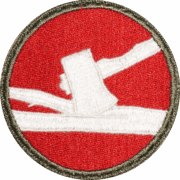 Dorn was assigned to the 84th Infantry Division, known as the “Railsplitters.” Tradition held that the division, originally composed of men from Illinois, Wisconsin and Kentucky, traced its lineage to the Illinois militia company in which young Captain Abraham Lincoln served during the Black Hawk War of 1832. The 84th shipped overseas in September 1944. After a period of organization, equipping, and training in England, the division landed at Omaha Beach at the beginning of November.
The 84th entered combat on November 18 with an attack on the German city of Geilenkirchen as part of a larger offensive to reach the Roer River. First Lieutenant Dorn led Company L of the 3rd Battalion of the 335th Infantry Regiment as it pushed forward to take the village of Beeck. Dorn was promoted to captain on December 3 as the Allies prepared an operation to cross the Roer River. Before they could act, the Germans launched their surprise offensive.
As Allied commanders realized the scope of the German attack, they also perceived the opportunity it presented to deal the enemy a crippling defeat. General J. Lawton Collins’s VII Corps, including the 84th, was pulled off the front lines to the north of the German bulge and redirected to the southeast to assemble as a counterattacking force. VII Corps would attack the German salient’s north flank while elements of General George Patton’s Third Army would attack it from the south, to encircle and trap the German attackers.
As VII Corps neared its designated assembly area, Collins feared that his forward elements might be pulled into the American defensive battle before they could organize for their counteroffensive. To prevent this eventuality, he moved the 84th forward to the Belgian town of Marche. Here two regiments, the 334th and 335th, took up positions to guard the assembly area from the Germans who were still fighting toward the west. In addition, the 335th sent forward its 3rd Battalion, including Dorn’s Company L, to establish a screening force in the vicinity of Rochefort, a smaller town eight miles to the southwest.
On December 23, the German Panzer Lehr Division, already running low on fuel for its tanks, attempted to break through American lines and capture Marche. Dorn’s company held the enemy at Rochefort in what devolved into house-to-house fighting. Dorn was killed in the action, but the German tanks were unable to break through to Marche. The German offensive ran out of gas—literally. December 23 marked its farthest advance. On December 24, Christmas Eve, the weather began to clear and Allied air forces began to help the men on the ground turn the battle back in the Allies’ favor.
The Battle of the Bulge, as it became known, was the biggest—and bloodiest—battle of US forces in World War II. More than 19,000 Americans were killed, including Captain Dorn, but the Germans were denied their objectives and spent their last reserves. Henceforth, the Allies held the initiative as they steadily pushed the Germans back to the Siegfried Line defending Germany’s western border.
Captain Olin Goode Dorn, Jr. was awarded the Bronze Star and the Purple Heart. He was survived by his wife, Mary, and his parents. Dorn was originally buried in the Henri Chappelle American Military Cemetery in Belgium and after the war was reinterred in the Sumter Cemetery.
For more information on Olin Goode Dorn, Jr. see:
https://soh.alumni.clemson.edu/scroll/olin-goode-dorn-jr/
For more information about Clemson University’s Scroll of Honor visit:
https://soh.alumni.clemson.edu/
See also A Time For Trumpets: The Untold Story of the Battle of the Bulge by Charles B. MacDonald, 1985.