
Scroll of Honor – John Robert Southerlin
Transport Pilot
Written by: Kelly Durham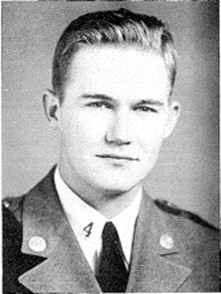
John Robert Southerlin, Clemson College Class of 1941, helped military aviation come of age during World War II. Rapid technological advances borne of existential conflict carried the state-of-the-art from fabric-covered biplanes to all-metal jets within a few chaotic years. The roles of aviation expanded along with the achievements in aircraft design and manufacture. In the Great War, airplanes had been used for scouting, or reconnaissance, and for primitive aerial bombing. World War II saw the advent of fast, maneuverable fighters and heavy, long-range bombers. The war was also the first time that aviation was used as a significant means of moving personnel and supplies within war theaters. Army Air Force transport planes, piloted by Southerlin and his contemporaries, carried paratroopers into battle, resupplied forward units, and moved military personnel all over the world.
Johnny Southerlin came to Clemson from Texarkana, Texas. He majored in civil engineering and was a member of the campus chapter of the American Society of Civil Engineers. Southerlin socialized with the Alpha Chi Psi fraternity and was in charge of decorations for the hops staged by the Central Dance Association. He also ran track for three seasons.
Following graduation in early June, Southerlin reported for active duty with the Army Air Force. He advanced through the phases of flight training and was designated as a multi-engine transport pilot. Southerlin was assigned to the 16th Squadron of the 64th Troop Carrier Group.
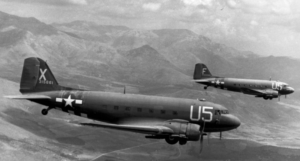 The troop carrier groups were expanding the role of aviation by working with the newly formed airborne units to drop paratroopers directly into combat. The 64th headed overseas in August 1942 as part of the first wave of American units to fly to Britain. Soon after its arrival, the group participated in the November invasion of North Africa, landing paratroopers on the airfield at Maison Blanche in French Algeria on November 11 and at Duzerville airfield near Bone on the following day. Subsequently, the air transport pilots ferried in fuel and anti-aircraft guns to help the paratroopers secure the airfields.
During the July 1943 invasion of Sicily, the 64th dropped paratroopers at Gela and Catania. Again, with the September invasion of Italy, the group delivered paratroopers over Avellino to destroy a key bridge on the German supply lines leading to Salerno.
In between dropping airborne forces into battle, the troop carrier group conducted resupply flights and ferried key personnel on planning, liaison, and other missions. On November 24, 1943, the day before Thanksgiving, Southerlin was a passenger on a C-47 aircraft carrying personnel and freight from Maison Blanche to Oran, about two hundred fifty miles east along the North Africa coast. At approximately 1000 hours, with the aircraft about fifteen miles out over the Mediterranean Sea, the right engine caught fire. The bail out order was given, but the plane lost altitude too quickly for parachutes to be used. The plane ditched in the water and, according to the accident report, “all personnel cleared the aircraft and attempted to don ‘Mae West’ life vests.” Three passengers were rescued by a French fishing boat, but Southerlin was lost and was listed as killed.
First Lieutenant John Robert Southerlin was awarded the Air Medal with two oak leaf clusters indicating the completion of at least fifteen combat missions. He is memorialized at the North Africa American Cemetery in Carthage, Tunisia and at Hillcrest Cemetery in Texarkana.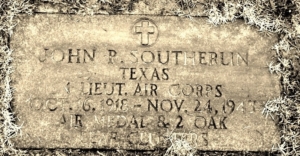
For more information on John Robert Southerlin see:
https://soh.alumni.clemson.edu/scroll/john-robert-southerlin/
For additional information about Clemson University’s Scroll of Honor visit:
https://soh.alumni.clemson.edu/