
Scroll of Honor – Grady Milford Dunlap
Changes
Written by: Kelly Durham 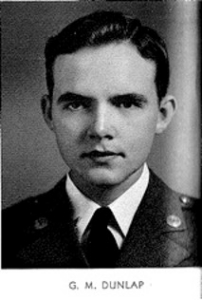
Perhaps no class witnessed such dramatic changes in its four years on campus as Clemson’s Class of 1941. The big news on campus, as the boys of the class arrived in the late summer of 1937, was the planned construction of the new $300,000 textile building. According to The Tiger, the structure would “follow the general plan of the buildings recently erected on the campus. In outside appearances it will conform with Riggs Hall, the school of Engineering, and Long Hall, the school of Agriculture.” Construction on the new building, eventually named Sirrine Hall, wouldn’t begin until 1939, but for textile engineering majors like Grady Milford Dunlap, the promise of modern facilities must have been attractive.
Dunlap was from the Spartanburg County textile mill village of Tucapau. At Clemson, he joined the Calhoun Literary Society, the Young Democrats Club, and the Spartanburg-Clemson Club. In the summer of 1940, Dunlap attended ROTC camp at Fort McClellan, Alabama. As a senior, he served as a cadet second lieutenant in Company A, 1st Battalion, 1st Regiment of the Cadet Brigade.
A lot changed during Dunlap’s four years at Clemson, and by the time he and his classmates graduated on June 2, 1941, the headlines had shifted from the construction of new buildings to military matters. With wars raging in 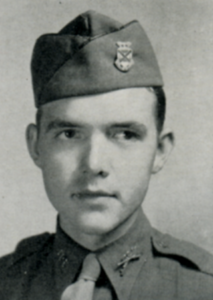 Europe and China, The Tiger reported that 1,300 cadets from twenty-seven schools were expected to attend ROTC summer camp on Clemson’s campus. Clemson would lead the way with a contingent of 300. The newspaper also predicted that the majority of the Class of 1941 would be in the Army before the end of the month.
The prediction proved correct for Dunlap. He entered service immediately after graduation and was assigned to the 13th Infantry Regiment of the 8th Infantry Division at Fort Jackson. After stateside training, the division embarked for overseas in the late autumn of 1943, arriving in Northern Ireland on December 15. During the first half of 1944, the division trained for the coming invasion of Europe.
The 8th Infantry Division landed at Utah Beach on July 4, 1944 and entered into combat three days later in the hedgerow country of Normandy. The Norman fields were bordered by mounded, thick hedges which served as ideal cover and concealment for the German defenders. The division’s progress was slow as the battle was renewed at each new field or pasture.
The division reached the north bank of the Ay River on July 13 and crossed the river on July 26. This bridgehead enabled the 4th and 6th Armored Divisions to penetrate German lines and drive into Brittany.
By early August, the 8th Infantry Division was closing in on the city of Rennes, a major road junction on the southwest flank of the American 12th Army Group. On Saturday, August 5, Second Lieutenant Dunlap was killed in action in the vicinity of Rennes.
Second Lieutenant Grady Milford Dunlap was survived by his parents and sister. In 1948, his remains were returned to the United States and he was interred in Cedar Grove Baptist Church Cemetery in Anderson.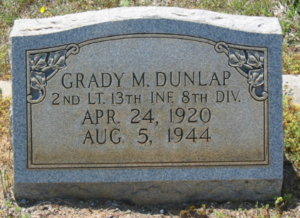
For more information on Grady Milford Dunlap see:
https://soh.alumni.clemson.edu/scroll/grady-milford-dunlap/
For additional information about Clemson University’s Scroll of Honor visit:
https://soh.alumni.clemson.edu/