
Scroll of Honor – George Albert Hamrick, Jr.
First Mission
Written by: Kelly Durham
The 379th Bomb Group had only recently arrived at its new base of operations at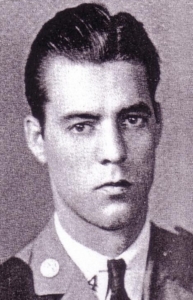 Kimbolton, England. It had flown its first combat mission to bomb the German U-boat pens at St. Nazaire, France at the end of May. Now, the 379th was poised for it first airstrike inside Germany. Leading the Group’s 527th Bomb Squadron on his first combat mission was Captain George Albert Hamrick, Jr., Clemson College Class of 1937.
Hamrick was an electrical engineering major from Lyman. He served as a platoon leader in Company A, 1st Battalion, 2nd Regiment of the Cadet Brigade. During his days on campus, two new buildings, each costing $400,000, were completed: the new Second Barracks and Long Agricultural Hall.
After receiving his degree, Hamrick took a job with the Georgia Power Company. Three years later, as the United States embarked on a belated military mobilization, Hamrick was called to duty and commissioned a lieutenant in the Army. He was assigned to the 2nd Armored Division as a tank commander. After the outbreak of war, Hamrick transferred to the Army Air Force. His flight instruction took place in Tulsa, Oklahoma and San Antonio, Texas, where he earned his pilot’s wings in September 1942. Hamrick’s operational combat training took place at Hendricks Field, Florida.
Hamrick then joined the unit he would eventually lead into aerial combat when he was assigned to the 379th Bomb Group. The group organized in November 1942 at Gowen Field, Idaho and then moved to Kearney, Nebraska. In April 1943, the group deployed to England, flying the North Atlantic ferry route and arriving at Kimbolton.
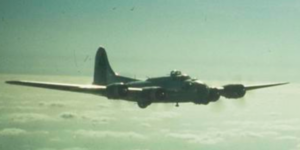 The American 8th Air Force was attempting to demonstrate that attacking specific strategic targets could cripple the German war industry and bring the war to a conclusion without resort to a costly amphibious invasion of Europe. Toward this objective, Army Air Force commanders had been launching missions of increasing size on ever-deeper penetrations into German-held territory.
On June 11, 1943, as the pilots and crews of the 379th gathered for their early morning briefings, they were informed that the day’s mission would take their B-17 Flying Fortresses over Germany for the first time. Their target would be the U-boat pens at Wilhelmshaven.
Two hundred fifty-two B-17s from multiple groups took off on the mission. As the bombers approached the target, the formation was attacked by German fighter aircraft. Out of the thirty-one bombers dispatched by the 379th Group, six were lost, two of which were piloted by Clemson men. Hamrick’s aircraft crashed near Grossheide. The only survivor from the crew was copilot Second Lieutenant Sam Gosen who was captured by the Germans. The other members of the crew were recovered and eventually buried at the Ardennes American Cemetery in Belgium.
According to the VIII Bomber Command’s mission report, “The raid on Wilhelmshaven demonstrates the difficulty of operating beyond range of fighter escorts as enemy fighter attacks prevent accurate bombing of the target.” The American bomber force would continue to suffer staggering losses until the introduction late in the year of the P-51 Mustang fighter. The Mustang had the performance and range to accompany the bombers on their long missions into Germany and would begin to slowly sweep the German Luftwaffe from the skies.
Captain George Albert Hamrick, Jr. was survived by his wife Dorothy, his parents, a sister, and two brothers. After the war, his remains were returned to South Carolina and reinterred in Elmwood Memorial Cemetery in Columbia.
For more information on George Albert Hamrick, Jr. see: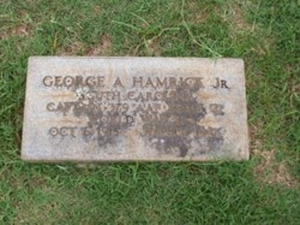
https://soh.alumni.clemson.edu/scroll/george-albert-hamrick-jr/
For additional information about Clemson University’s Scroll of Honor visit:
https://soh.alumni.clemson.edu/
Photo courtesy The American Air Museum in Britain.