
Scroll of Honor – Ernest Hill Carroll, Jr
Omaha Beach
Written by: Kelly Durham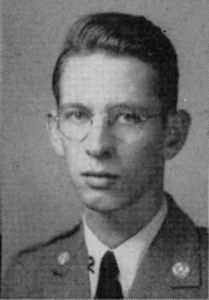
His father, a Rock Hill businessman, enlisted in the Marines at age 40 and fought the Japanese at Guadalcanal, so it should come as no surprise that Ernest Hill Carroll, Jr. also enlisted in the service. The younger Carroll entered the Army in December 1942. Fittingly, he was assigned to a combat engineer outfit.
Sonny Carroll grew up in Rock Hill where his parents owned a bottling company and radio station. In 1940, he graduated from Winthrop Training School where he was elected class president. In the fall of 1941, with war clouds gathering, Carroll became the first of his family to go to college, enrolling at Clemson as a mechanical engineering major in the Class of 1945. He remained at Clemson through the first semester of his sophomore year before following his father’s example and enlisting.
Sonny was ordered to Fort McClellan, Alabama for basic training and then to Fort Meade, Maryland for engineer training. In January 1944, he shipped overseas as part of the continuing build-up of American and Allied forces in the United Kingdom. Sonny joined
Company B, 121st Engineer Combat Battalion. Sonny’s battalion was attached to the 29th Infantry Division, destined to land on Omaha Beach in D-Day’s first wave.
Sonny’s battalion prepared for the coming invasion with vigorous training. The Army had created several amphibious training centers along the shores of coastal England and the engineer units practiced their missions alongside the infantry outfits they were designated to support. Sonny’s battalion would support the 29th Infantry Division’s 116th Infantry Regiment.
Historian Stephen Ambrose wrote that “The combat engineers had the most complex job.” Nearly one-quarter of the American troops going ashore on the morning of D-Day would be engineers. “Their tasks, more or less in order, were to: demolish beach obstacles, blow up mines on the beach, erect signs to guide incoming landing craft through cleared channels, set up panels to bring in the troops and equipment (the color of the panel told the ships offshore which supplies to send in), clear access roads from the beach, blow gaps in the antitank wall, establish supply dumps, and act as beachmasters (traffic cops).” And by the way, the Germans would be a factor as well.
H-Hour, the time of the initial landing on Omaha Beach, was scheduled for 0630 hours, an hour after first light. Sonny Carroll’s battalion was scheduled to arrive on the Dog White sector of the beach forty minutes later, by which time the Germans were on full alert.
Carroll’s landing was greeted with murderous mortar, artillery, and intersecting machine gun fire crisscrossing the beach. No infantry units had preceded the engineers on their sector of the landing area. Rough seas and shifting sands meant that some landing craft could not make it all the way onto the beach. Heavily laden men were forced to jump over the sides of the boats, often into water that was over their heads, and struggle against the surf, the sand, and the withering enemy fire to get ashore.
Private Carroll was a mine detector. As he stepped off the landing craft, he was plunged into cold, neck-deep water, his backpack soaking up water like a thirsty drunk. With bullets zipping past his head, mortar shells erupting nearby, and weighed down by heavy gear, Carroll was pulled under and drowned. Approximately fifty percent of the initial landing forces were casualties and seventy-five percent of their equipment was lost.
There were 2,200 casualties on Omaha Beach that day, but 40,000 men landed and by nightfall they clung to a tenuous beachhead they would never relinquish. The landings were the first step in the liberation of France and sounded the death knell for Hitler’s Third Reich.
 Private Ernest H. “Sonny” Carroll, Jr. was awarded the Purple Heart. After the war, his remains were returned to Rock Hill and buried in the Laurelwood Cemetery. In 2010, through a $1 million bequest, his parents established the Ernest Hill Carroll Jr. Endowed Scholarship Fund to provide assistance to worthy Clemson students. It was a fitting gift to honor a selfless sacrifice.
Learn more about Sonny Carroll here.
For more information about Clemson University’s Scroll of Honor, click here.
The best of many excellent books on the Normandy landings is D-Day, June 6, 1944: The Climactic Battle of World War II by Stephen Ambrose, 1994.