
Scroll of Honor – Edward Parker Sanders, Jr.
Advanced Phase
Written by: Kelly Durham
Brigadier General Herbert Dargue, the Army’s assistant chief of aviation, told Time magazine in 1940, “that preparation for war takes its toll as well as war itself and that there is no more hazardous profession at arms than that which the combat flier has elected to follow.” At the time of Dargue’s statement, the Army Air Corps was experiencing 10 fatal accidents per 100,000 flight hours. As training accelerated after the United States entered World War II, the rate would mushroom to 19. Accidents, including fatal ones, would plague all phases of flight training, but by far the most hazardous was the advanced phase.
Edward Parker Sanders, Jr. was a member of Clemson’s Class of 1944 from Columbia. He was a civil engineering major and a member of the American Society of Civil Engineers. He was a sergeant in F Company, 2nd Battalion, 2nd Regiment of the Cadet Brigade. With the end of his junior year in the spring of 1943, “EP,” like most of his classmates, reported for military service.
Sanders first attended basic training at Camp Croft, near Spartanburg. Accepted into the Army Air Force flight training program, Sanders next journeyed to Maxwell Field at Montgomery, Alabama, for pre-flight training. During this initial phase, aviation cadets were instructed on the Army and the process of becoming officers. They received physical and military training and participated in supervised athletics.
The next phase was primary flight training, which for Sanders took place at Carlstrom Field in Arcadia, Florida. This was the cadet’s real introduction to flying and the most critical step in the flight training process. In the primary phase, cadets took to the air in a simple training aircraft with an instructor to develop the skills and attributes necessary to become competent flyers. The accident rate here was 48 per 100,000 flying hours. Of course, not all accidents were fatal, but during the course of the war, 439 airmen were killed in primary training mishaps.
Sanders went to Greenwood Army Air Base in Mississippi for basic flight training. Here, Sanders was introduced to more complex aircraft with flight instruments and more powerful engines. This phase of training included more advanced flying skills like acrobatics, formation flight, instrument flight, and nighttime flying. By this point in training, pilot candidates with weaker skills had often been “washed out,” or eliminated from flight training, so accident rates were lower. Still, 1,175 airmen were killed in basic flight training accidents over the course of the war.
After completing basic, aviation cadets would be assigned to either advanced single-engine or advanced twin-engine training. Sanders was selected for the latter and moved 110 miles east to the Army Flying School in Columbus, Mississippi. Advanced training was dangerous due to several factors. At this point, the prospective pilots had advanced through a rigorous curriculum and were feeling confident. General Hap Arnold, head of the Army Air Force, warned that the advanced cadet “becomes overconfident and knows more about flying than he will ever know again.” Once more, cadets were stepping up to more complicated aircraft. In Sanders’s case, he now had to manage two engines, more instruments, and retractable landing gear.
 On January 5, 1945, Sanders was in his last month of the advanced phase of flight training after which he would pin on his pilot’s wings. His training flight that day was likely in an AT-17 Bobcat, an advanced twin-engine trainer built by Cessna. The aircraft crashed at Columbus and Sanders was killed.
Aviation Cadet E.P. Sanders was among 1,888 fatalities to occur during the advanced phase of Army Air Force flight training during the war. Military flying was indeed, as General Dargue had pointed out, a “hazardous profession.” In all, 15,000 Americans died in noncombat aviation accidents during the war, the equivalent of an infantry division and approximately ten times the number of American deaths on D-Day. The high rate of accidents and fatalities was part of the price the Army Air Force paid to meet the demand for wartime pilots and aircrews.
For more information on Edward Parker Sanders see: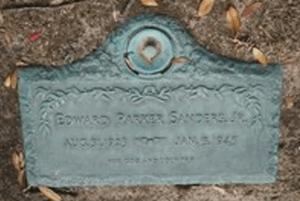
https://soh.alumni.clemson.edu/scroll/edward-parker-sanders/
For additional information about Clemson University’s Scroll of Honor visit:
https://soh.alumni.clemson.edu/
See also EARNING THEIR WINGS: ACCIDENTS AND FATALITIES IN THE UNITED STATES ARMY AIR FORCES DURING FLIGHT TRAINING IN WORLD WAR TWO, by Marlyn Pierce, Kansas State University, 2013.
See also EARNING THEIR WINGS: ACCIDENTS AND FATALITIES IN THE UNITED STATES ARMY AIR FORCES DURING FLIGHT TRAINING IN WORLD WAR TWO, by Marlyn Pierce, Kansas State University, 2013.