
Scroll of Honor – Charles Carroll Biggerstaff
Bombing Test
Written by: Kelly Durham
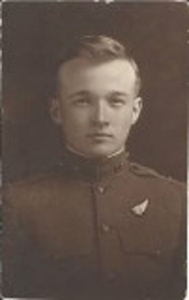
Charles Carroll Biggerstaff of Rowesville arrived on the Clemson Agricultural College campus in the late summer of 1916, enrolling as a member of the Class of 1920. He was assigned to Company H of the Cadet Corps and attended the Sunday School Class taught by Professor Bryan.
Halfway through his sophomore year, in January 1918, Biggerstaff left school to enlist in the Army Air Service. His first training assignment was to the military school of aeronautics at Austin, Texas. Following ground school training there, Biggerstaff headed to Fort Sill, Oklahoma, to attend the Army School of Fire.
In September 1919, Biggerstaff was ordered to Siberia as part of a replacement troop cohort. President Wilson had sent an American Expeditionary Force to Siberia in the wake of the Russian Revolution. The role of this force was to facilitate the withdrawal of friendly Czechoslovaks from the region and to protect military supplies and railroad equipment that the United States had supplied to the Russian Empire during the Great War. When the AEF was withdrawn, Biggerstaff was sent from the frozen tundra to the tropical jungles of the Philippines.
In September 1920, Biggerstaff went to Buffalo, New York and enrolled in the Bancroft school. In December, he reenlisted in the Air Service and was transferred to Mitchell Field, Long Island. In May 1921, Biggerstaff was assigned to the First Observation Squadron and ordered to Langley Field, Virginia, to assist with naval bombing tests.
Airplanes had been used extensively during the Great War. Army and Navy commanders agreed that airplanes would play a more vital role in future conflicts. What they didn’t agree on was the organization that air forces should take and which service should be in charge. Army General Billy Mitchell advocated for a separate air force, merging the Army and Navy’s aerial assets. Mitchell proclaimed that airplanes could sink battleships and that air forces would make ground armies and surface navies obsolete. To test the theory, experiments were conducted off the Virginia Capes in the summer of 1921. Navy, Marine, and Army aircraft participated in the tests, which targeted ships confiscated from Germany in the aftermath of the war.
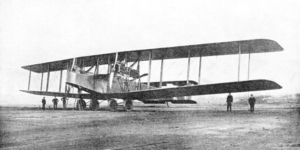
A Handley Page bomber. Note the position of the propellers.
According to a 1959 Navy report, the bombing experiments “marked another milestone in the age-old competition between the attacking weapon and passive defense – like the spear against the shield – the gun against armor, and then the aerial bomb against an armored ship.” The tests demonstrated the vulnerability of warships to aerial attack but did little to alleviate the debate about which branch of the armed forces should control air power. The tests came at a cost. Aircraft were lost and damaged and at least one pilot drowned when his airplane crashed into the ocean.
And then there was Biggerstaff. As he helped prepare an Army bomber for a mission and was moving from its tail area around to its cockpit, he was struck and killed by a spinning—and therefore nearly invisible—propeller.
A newspaper report noted that Biggerstaff “was highly esteemed by the officers for his studious habits and conscientious observance of all regulations. He won the affection of his comrades by his unselfish consideration of others.” Sergeant Biggerstaff was buried at the National Cemetery in Hampton, Virginia. He was awarded the World War I Victory Medal and was survived by his mother and sister.
For more information on Charles Carroll Biggerstaff see:
https://soh.alumni.clemson.edu/scroll/charles-carroll-biggerstaff/
For additional information about Clemson University’s Scroll of Honor visit:
https://soh.alumni.clemson.edu/