
December 7
December 7
On December 7, 1942, the first anniversary of the Japanese attack on Pearl Harbor that thrust the United States into World War II, John David Trimmier visited with his father, Lloyd, in Spartanburg. The younger Trimmier was the copilot on a B-25 Mitchell medium bomber on a transition training flight with a stopover in Spartanburg. His father, Lloyd, worked for Greenewald’s, the men’s clothing store in the city. After their visit, John and his crew climbed back aboard their aircraft for the return flight to Columbia Army Air Base.
December 7 of the previous year had been a pivotal date in the lives of millions of Americans, especially those of young men. Less than six weeks after Pearl Harbor, Trimmier entered military service at Camp Croft, the basic training facility south of Spartanburg.
Trimmier was from nearby Inman and had attended Clemson College from 1938 to 1940 as a member of the Class of 1942. A textile engineering major, Trimmier left campus after his sophomore year and enrolled at the Palmetto Air School in Spartanburg. This flight training prepared Trimmier for what was to come.
After completing basic training at Camp Croft, Trimmier was sent west for flight training to become an Army Air Force pilot. Trimmier studied the theoretical and practical aspects of flight at Thunderbird Field near Scottsdale, Arizona; Chandler Field at Fresno, California; and Williams Field in Chandler, Arizona. He completed his flight training in July 1942.
Trimmier’s next assignment returned him to South Carolina. The 309th Bomb Group was a training unit based at Columbia’s Army Air Base. The group’s mission was to prepare pilots and aircrews for operational—that is, combat—flying.
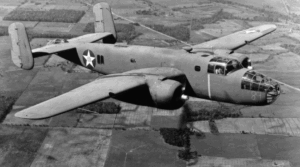 As the United States began its second year of war, Trimmier and his crew took off from Spartanburg for the return flight to Columbia. At 1308 hours, the aircraft, piloted by Second Lieutenant Robert Thomas, received its clearance to land. According to the official accident report, the B-25 crashed two minutes later about nine miles southeast of Columbia. Investigators speculated that the bomber entered clouds and went into a steep spiraling right turn. Once it broke through the cloud cover at only 600 feet, they believe that the pilot pulled up violently, imposing too much stress on the wings and causing the aircraft to break apart. The investigators also surmised that icing on the wings and control surfaces may have contributed to the crash. All seven crew members aboard the aircraft were killed.
Second Lieutenant John David Trimmier was survived by his parents, two brothers, and three sisters. He is buried in the Inman Presbyterian Church Cemetery.
For more information about John David Trimmier, see:
https://soh.alumni.clemson.edu/scroll/john-david-trimmier/
For additional information about Clemson University’s Scroll of Honor visit: