
Scroll of Honor – James Gay Hickerson
Textbook Soldier
Written by: Kelly Durham
Jim Hickerson seemed predestined for a military career. The Greensboro native attended prep school at Edwards Military Institute in Salemburg, North Carolina. He then enrolled at the all-military Clemson College as a member of the Class of 1949.
An arts and sciences major, Hickerson impressed his fellow cadets with the military bearing of a “textbook soldier.” He was awarded the Simpson Medal as the best drilled cadet in his class. His proficiency in drill earned him a spot on the Senior Platoon drill team and the Pershing Rifles, which he served as captain. As a senior, he served as a cadet major and a battalion executive officer until a mid-year vacancy opened and he was promoted to regimental executive officer. His achievements within the Cadet Regiment led to Hickerson’s selection as a Distinguished Military Student. But Jim Hickerson’s talents were not confined to the military aspect of life on campus. He also sang in the Glee Club and served on the YMCA Council. Hickerson was selected for inclusion in Who’s Who Among American Colleges and Universities. The esteem in which he was held by his classmates is reflected in his election to the Senior Council, which served as “the connecting link between student body and the administration.”

Jim Hickerson, second from right, parades on Bowman Field as executive officer of the Cadet Regiment’s 3rd Battalion.
Hickerson graduated in June 1949 and was commissioned a second lieutenant in the Regular Army. He attended the Basic Infantry Officer Course at Fort Benning, Georgia where he also qualified as an Army paratrooper, earning his jump wings. After completing school, Hickerson was assigned to the 7th Cavalry Regiment of the 1st Cavalry Division then stationed in Japan as part of the occupation forces.
When North Korean forces invaded South Korea in June 1950, the 1st Cavalry Division was one of the first American units sent to the peninsula. Hickerson’s 7th Cavalry Regiment landed at Pohang-dong, eighty miles north of Pusan, on July 22. The 7th was committed to combat on July 25, exactly thirty days after the North Korean invasion.
Over the next few days, the 7th protected the main highway leading southeast from Seoul. The regiment gradually fell back to defensive positions forming what would become the Pusan Perimeter, the United Nations toehold on the southeast corner of the Korean peninsula.
For fifty days, the 7th held its section of the perimeter against heavy attacks from North Korean forces. On August 9, Hickerson’s 1st Battalion was ordered to attack enemy forces on Hill 268. Supported by tanks and artillery, the battalion seized the hill, killing four hundred enemy soldiers. The battalion continued to push forward, seizing additional high ground until it was relieved and pulled off the line to serve as the 1st Cavalry Division’s reserve.
In response to renewed heavy attacks by the enemy, the division withdrew to shorten its lines and occupy stronger defensive positions. In desperate fighting near Taegu (Daegu), on September 10, Hickerson was wounded, earning the Purple Heart medal.
While he was out of action, General MacArthur, the commander of all United Nations forces in Korea, executed an amphibious landing at Incheon, on South Korea’s northwest coast. A corresponding breakout from the Pusan Perimeter into which UN reinforcements had been flowing, lead to the encirclement of North Korean forces in the south.
By the time Hickerson returned to 1st Battalion on October 23, the 7th Cavalry was moving north. UN Forces rolled through North Korea and reached its border with China in late October. On October 25, Communist China intervened and began pushing UN troops back from its border. The 7th counterattacked, but on November 26, Chinese forces penetrated the regiment’s front line companies. The sheer size of the Chinese attacks combined with bitter cold, forced UN troops to fall back. By the end of 1950, the Chinese had pushed UN forces back into South Korea.
On January 22, 1951, the 7th Cavalry launched an attack on Chinese lines near Kyong-ni. On Sunday, January 28, First Lieutenant Hickerson’s platoon was on the point of a battalion movement when a large enemy force suddenly opened fire from in front and on both flanks. Hickerson, according to the citation for his Silver Star medal, “quickly deployed his machine gun and 57 mm recoilless rifle section into advantageous positions and returned fire.” In the face of heavy enemy fire, Hickerson moved from “man to man to give encouragement and fire directions.” After silencing the enemy to his front, Hickerson began to reposition the recoilless rifle. “…he courageously moved among his weapons, fully exposed to the enemy, to give fire directions and advice. While in the midst of this dauntless act, Lieutenant Hickerson was struck by hostile fire…” Hickerson died from his wounds the following day.
The Korean War would drag on for two and a half more years, halted by an armistice in July 1953. After all the fighting and destruction and three million deaths, the pre-war boundary between the two Koreas was restored. More than thirty-three thousand Americans were killed in battle, including promising young leaders like James Gay Hickerson. Jim Hickerson was awarded a second Purple Heart and the Silver Star. He is buried in Forest Lawn Cemetery in Greensboro.
For more information on First Lieutenant James Gay Hickerson see: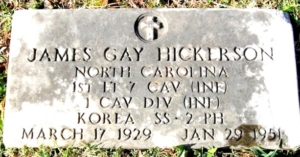
https://soh.alumni.clemson.edu/scroll/james-gay-hickerson/
For additional information about Clemson University’s Scroll of Honor visit:
https://soh.alumni.clemson.edu/