
Scroll of Honor – Robert Alson Coltrane
Bombardier
Written by: Kelly Durham
Robert Alson Coltrane was working his way up within Clemson’s Cadet Brigade. Like all the boys, he had started out as a private in his freshman year. The mechanical engineering major from Columbia was promoted to corporal as a sophomore and, at the beginning of his junior year, was designated a cadet sergeant. He was also a member of the Supply Sergeants Club. But then, everything changed. The week after the Japanese attack on Pearl Harbor, Clemson President Robert F. Poole advised the cadets to “remain calm” and to “work as hard as possible on their courses and prepare themselves that they may serve their country efficiently when called.” Many heeded that advice. Robert Coltrane was less patient.
Following the Christmas holidays, Coltrane, rather than returning to campus, enlisted in the Army Air Forces. He completed basic training at Maxwell Field, Alabama. His next stop was the Army Air Force’s “Bombardier College” at the Midland Army Flying School in West Texas. There, Colson earned his bombardier’s wings and was commissioned a second lieutenant in May 1942.
In August, Coltrane, now assigned to a flight crew, arrived in England. His crew was initially ordered to the 92nd Bomb Group at Bovingdon. The 92nd flew a few combat missions in August and September and then transitioned to an operational training unit to receive and distribute replacement crews to the other combat groups operating in England. Coltrane and his crew were transferred to the 358th Bomb Squadron of the 303rd Bomb Group at Molesworth, about sixty miles north of London.
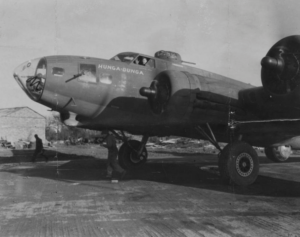
Coltrane’s B-17F, Hunga-Dunga, prepares to taxi.
Coltrane was the bombardier on a B-17F heavy bomber nicknamed Hunga Dunga, piloted by First Lieutenant Charles Austin. On March 18, 1943, Coltrane, Austin, and their crew were alerted for a mission to Vegesack, Germany to attack the U-boat construction facilities there. It would be Coltrane’s tenth—and last—mission.
Seventy-six B-17s and twenty-seven B-24s took off to bomb the Bremer Vulkan-Vegesacker Werft on the Weser River in Bremen. This was the first mission to link the new Automatic Flight Control Equipment to the bombers’ sophisticated—and TOP SECRET—Norden bombsight. The new set-up enabled Coltrane and the other bombardiers to fly the aircraft by making bombsight adjustments during the bomb run.
The bomber formation was at 24,000 feet about seven minutes short of the target when it was attacked by German fighter aircraft. At approximately 1510 hours, Hunga-Dunga was hit and caught fire, forcing Lieutenant Austin to pull it out of formation. He attempted to turn his damaged aircraft back toward England, but it was losing altitude. Austin ordered the crew to bail out. The navigator jumped through the B-17’s lower front hatch, followed by the copilot, Austin, and then Coltrane. The radio operator, top turret gunner, and one of the waist gunners jumped out through the open bomb bay doors.
Austin landed near Oldenburg and was soon taken into custody. He was transported to a German garrison on Wesermundestrasse. As he was being taken to a cell, a German guard approached Austin and showed him a copy of Lieutenant Coltrane’s dog tag. The guard said, “This man is dead.” Five members of Austin’s crew were taken prisoner. The other five, including Coltrane, were killed. Although strike photos showed that the mission had caused heavy damage to the U-boat works, the 8th Air Force suffered thirty-seven casualties and lost three aircraft with twenty-three more damaged. It would take another year and a half of heavy losses before the Allies achieved air superiority in the skies over Europe.
First Lieutenant Robert Alson Coltrane was awarded the Air Medal and the Purple Heart. He was survived by his parents and his brother. After the war, his remains were returned to Columbia and buried in the Greenlawn Memorial Park.
For more information on Robert Alson Coltrane see:
For additional information about Clemson University’s Scroll of Honor visit:
https://soh.alumni.clemson.edu/
Hunga-Dunga photo courtesy The American Air Museum in Britain.