
Scroll of Honor – Irvin William West
From D-Day to Saint-Lô
Written by: Kelly Durham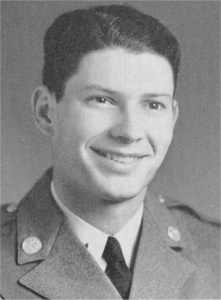
First Lieutenant Irvin William West sailed for Europe in May 1944, just in time for the largest amphibious operation in history, the D-Day landings in Normandy. West was assigned to the 116th Infantry Regiment of the 29th Infantry Division. The 116th, which traced its lineage to the Virginia Militia of the colonial period, was drawn from Virginia National Guard units, a fitting assignment for West who hailed from Richmond.
Although his hometown was Richmond, West was no stranger to South Carolina where he spent much of his childhood and where his father was in the lumber business. West was a member of the Class of 1942, the first to leave campus after the United States entered World War II. A general science major, West was an honor student. He served as a cadet First Lieutenant assigned to I Company, 3rd Battalion, 1st Regiment in the Cadet Brigade. He completed ROTC camp at Clemson in the summer of 1941, qualifying as a marksman on the firing range. Immediately following graduation and his commissioning as a second lieutenant in the infantry, West reported for active duty.
West served at Army posts in Texas, Georgia, Kentucky, and Missouri. He also found the time to marry the former Alice Monroe of Marion before heading overseas in the critical spring of the European war.
On D-Day, the 116th Infantry was in the first wave, landing on the DOG sectors of Omaha Beach. No American regiment suffered more grievously. Fifty-six percent of A Company, most of whose men were from the town of Bedford, Virginia, were killed within the first minutes of landing on DOG-Green beach. By the end of D-Day, the 116th had suffered casualties of more than thirty-five percent. But the end of the day didn’t mean the end of the fighting. The regiment moved to Pointe du Hoc to reinforce the Rangers who had earlier scaled its sheer cliffs and who faced a long night of German counterattacks. The 116th was finally withdrawn to a rest area on June 11. There it reorganized and received replacement officers and soldiers.
Over the following days, as the Allied buildup of troops, vehicles, and supplies streamed across the beaches and crammed into the beachhead, commanders struggled with how to breakout of the restrictive hedgerow country with its thick hedge barriers at the edge of every field. General Omar Bradley, commander of the US First Army, focused his attention on seizing the road network converging at the town of Saint-Lô, about forty kilometers south of the invasion beaches.
On June 13, the 116th moved forward crossing the Ellé River and advancing toward Saint-Lô. By June 17, the regiment was still three miles from its objective as the Germans made effective use of Normandy’s hedgerows to bog down the American advance. Saint-Lô was finally captured on July 19, two days after First Lieutenant West’s twenty-fifth birthday and one day after he was killed.
The capture of Saint-Lô came at a high price. From D-Day through July 19, the 116th suffered eighty-one percent killed, wounded, or missing. But the seizure of the town and its network of roads readied Bradley’s forces for Operation Cobra, the combined arms operation that would commence July 25 and result in the long anticipated breakout from the Normandy beachhead. “I have a hunch,” wrote correspondent Ernie Pyle, “that July 25 of the year 1944 will be one of the great historic pinnacles of this war. It was the day we began a mighty surge out of our confined Normandy spaces, the day we stopped calling our area the beachhead and knew we were fighting across the whole expanse of France.” After Cobra, the Germans would be forced to begin their long retreat to the borders of the Third Reich. 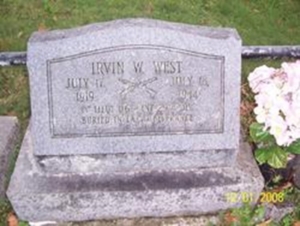
Irvin William West was survived by his mother and his wife. After the war, his body was returned to South Carolina where he was buried in Marion’s Rose Hill Cemetery.
For more information on First Lieutenant Irvin William West see:
https://soh.alumni.clemson.edu/scroll/irvin-william-west/
For additional information on Clemson University’s Scroll of Honor visit:
https://soh.alumni.clemson.edu/
See also The Battle of the Generals: The Untold Story of the Falaise Pocket—The Campaign that Should Have Ended World War II, by Martin Blumenson, 1993, and The First Wave: The D-Day Warriors Who Led the Way to Victory in World War II, by Alex Kershaw, 2019.