
Scroll of Honor – Bennett McKellar Reynolds
La Hay du Puits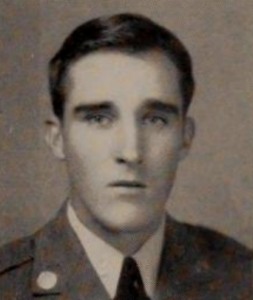
Written by: Kelly Durham
One of the many fascinating chapters of the story of D-Day concerns the artificial harbors known as “Mulberrys.” These ingenious devices were constructed in Britain of steel and concrete, then towed across the English Channel and anchored off the invasion beaches. The Mulberrys were designed to handle 7,000 tons of vehicles and supplies per day, yet they were conceived as only temporary answers to supplying the ever-growing Allied forces streaming across the beaches and into France. To sustain long-term combat operations, Allied commanders planned to capture the major ports of Caen in the British sector and Cherbourg in the American zone. Bennett McKellar Reynolds, Clemson Class of 1944, served with the 79th Infantry Division, which entered Cherbourg on June 25, 1944.
Bennett Reynolds was an agricultural education major from Bennettsville, SC. He was a member of the Presbyterian Students Association and sang with the Glee Club. He completed his junior year at Clemson and then entered active duty in June 1943.
Reynolds’s basic training took place at Camp Croft in Spartanburg. Then, he briefly returned to Clemson as a participant in the Army Specialized Training Program. From Clemson, he was ordered to Fort Bragg, North Carolina and then to Fort Meade, Maryland. He arrived in England on May 11, 1944, just in time for the invasion.
The 79th Infantry Division began landing on Utah Beach on June 12. It entered combat a week later, attacking to the north along the Cotentin Peninsula, at the tip of which was the highly valued harbor of Cherbourg. The division battled its way into the port city on June 25. Once they realized they could not hold Cherbourg, the Germans did a thorough job of wrecking the harbor. It would take the Allies weeks to make the port’s facilities usable.
In the meantime, the 79th turned south to push the Germans out of the peninsula. The Americans needed to enlarge the beachhead, or lodgment area, to make room for the newly arriving units, which would help launch an offensive into the tank-friendly French countryside south of Normandy. La Hay du Puits was a commune featuring the junction of key roads. The Germans had moved into the town in June 1940. Now, the 79th planned to evict them.
On July 5, the 79th began its assault on the town. Against stiff German resistance, the attack made slow progress. Over the following day, the 79th’s infantry regiments slowly encircled the town, forcing the German occupiers to withdraw to avoid being cut off. But, as was their habit, the Germans counterattacked the next day, forcing the 79th to give ground before gradually regaining the initiative. By the end of the day, the division had suffered one thousand casualties.
On July 8th, the attack was resumed with the 79th pushing ahead with tanks supported by engineers and infantry. High casualties had forced many sergeants to take over their units as junior officers were killed or evacuated due to wounds. On July 9, the division attacked into the town, rooting German defenders out of the rubble. Private Reynolds was wounded during the fighting and died that same day.
Private Bennett McKellar Reynolds was survived by his mother and his half-brother, who was also serving in the Army. He was awarded the Purple Heart. He is buried in McCall Cemetery in Bennettsville. 
For more information about Bennett McKellar Reynolds see;
https://soh.alumni.clemson.edu/scroll/bennett-mckellar-reynolds/
For additional information on Clemson University’s Scroll of Honor visit:
https://soh.alumni.clemson.edu/